
Everything Your Father Never Told You
About Shaving
(12 shaving tips everyone should know)
Written with barber Simon
Maybe your father belonged to the generation that grew up believing electric shavers were the sound of the future? Or perhaps he belonged to the throwaway generation that saw disposable products as the modern answer to all everyday problems?
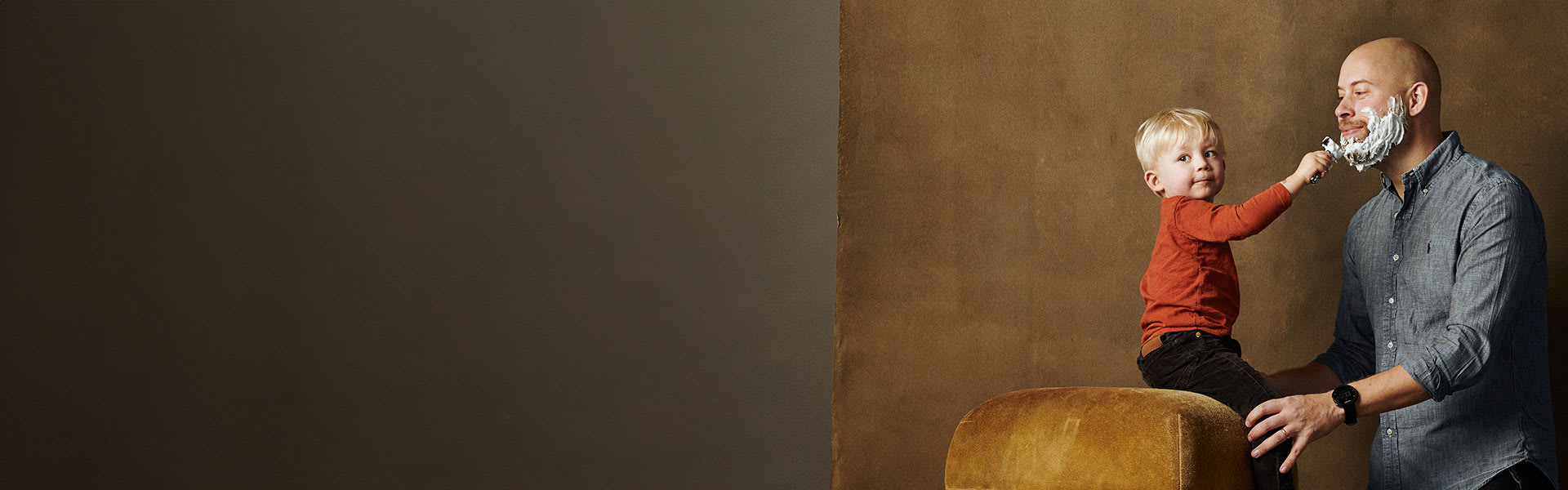
There is, of course, also a small chance that he was one of the few who resisted the advertising and continued with classic shaving. But however it may be, a lot of shaving knowledge has been lost over the past half century as large companies have done everything in their power to get us to use their patented products. And that is hardly your father’s fault. So here are 12 shaving tips we wish all men knew. And women too, of course, because most of these tips work for everyone.
#1
Safety razor, shavette or straight razor
What should you choose? We all have different tastes, conditions and needs, but put simply, you could say that the safety razor is the perfect choice for most people because it is easy to maintain, easy to use, and delivers reliable results. But did you know there are also several different types of safety razors? The shavette, on the other hand, demands more of your shaving technique but also gives you more control over the details. Barbers often combine the two and use the safety razor for larger areas, saving the shavette for fine detailing and beard lines. Finally, the straight razor requires both technique and care, but in return offers a much greater sense of ritual and is therefore something of a lifestyle choice for the enthusiast. We are not covering electric razors here because, unfortunately, they cannot provide a truly close shave and are therefore best suited to those with exceptionally sensitive skin.
#2
Your first shave is a rite of manhood...
...even if it is a rather informal and early one. And then you naturally want to invest in proper tools, because that sense of ceremony you will probably remember for the rest of your life cannot be the same with cheap disposable products.
#3
Some things really were better in the past...
...and what people used to shave with is a good example. A classic safety razor costs a little more than the big companies’ subsidised specialist razors, but that investment gives you a better shave and quickly pays for itself because the blades are also much cheaper. Razor blades should be changed regularly before they become worn out, which is important for the result but also to protect both your skin and your razor.

#4
Prepare by taking a hot shower...
...because heat and moisture make beard hairs soft and easier to shave off. If you have coarse beard growth and sensitive skin, you can also apply a little pre-shave before stepping out of the shower so it has a few extra minutes to work. If you do not want to shower then, you can instead do as barbers do and wrap your face in a warm, damp towel for a couple of minutes.


#5
As mentioned, use a pre-shave
It reduces friction between the blade and the skin, making shaving both easier and gentler. Sometimes a pre-shave can even be the only product you need, for example if you just want to tidy up your beard lines. Pre-shave is applied to a warm, damp beard and comes in several forms, but what they all have in common is that they do not foam. Shaving oil is the most common, but there is also pre-shave gel and cream. If the oil cools down, it can thicken, so rinse your razor in lukewarm water between each stroke, and splash a little extra warm water on your face if needed. But do not rinse the blade in water hotter than lukewarm, as higher temperatures can affect the tempering and reduce the sharpness and lifespan of the blade.
#6
Check which direction your beard grows
If you have trouble seeing which way your beard hairs grow on different parts of your face, try dragging a credit card along the skin. If it moves easily, you are moving it in the right direction, with the grain. The first stroke with the razor should also go in that direction, and possibly a second one as well, but then you can lather the skin again and do the third stroke in the opposite direction for a really close shave. Two or three strokes in one area is usually enough unless you have especially resilient skin.
#7
Use shaving lather, and let it sit for a couple of minutes...
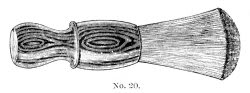
...before you begin shaving. For thin and sparse Nordic beard growth, ready-made shaving foam in a spray can is usually enough. Just shake it and apply it to a wet, warm beard. But if you have normal to heavy beard growth and want to see what you are doing more easily, then transparent shaving gel is the way to go. Shaving cream is the next option, whipped up with your fingers or with a shaving brush, which can also work wonders when it is time to apply the lather. The brush lifts the beard hairs while distributing the lather more effectively between them, and it can also help brush the skin and remove dead skin cells. If that sounds good, experts agree that the best brushes are made from badger hair. Last but not least, we have shaving soap, the most economical option and the one with the most retro feel, best suited to those with especially oily skin.


#8
Start shaving where the beard growth is thinnest
That way the shaving lather has more time to work on the heavier areas where it is needed most. This usually means starting at the sides of the face, moving on to the neck, and finishing around the mouth, chin and under the neck. Or you can leave the most sensitive areas of the skin until last, since that is where rashes are most likely to appear, and that is usually the neck. But experiment and see what works best for your beard and skin. Remember, the more you shave, the better you will become at shaving your own contours and skin areas gently and skillfully.
Practice makes perfect. After a long time of practicing, our work will become natural, skillfull, swift, and steady.”
― Bruce Lee
#9
Stretch the skin...
...even if it is young and firm. When shaving your neck, for example, you can tilt your head back and gently pull at the lower part of the skin on your neck. This allows the blade to move more smoothly, which prevents cuts and irritation. The upper lip can also be problematic, so try stretching it from the inside with your tongue, or puffing out your cheeks with air.

#10
Small, calm and light strokes...
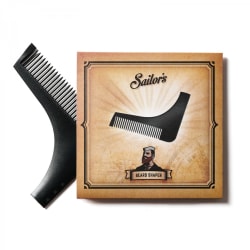
...also reduce the risk of cuts. But if an accident still happens, it is no major problem, because an alum stick works perfectly well and stops the bleeding immediately. Rinsing after each stroke and applying fresh lather from time to time are other tricks that make shaving easier. If you are shaving your beard contours and the lather prevents you from seeing where you are placing the razor, you can use a shaving template. Just press it against the skin and shave along the edge, first on one side and then mirrored on the other side of the face. That way you get an even and symmetrical shape and avoid the problem of seeing the contours through the lather. Here are even more tips on shaving technique.


#11
Finish the shave with lukewarm water...
...and pat yourself dry with a towel. Shaving with a razor is naturally exfoliating, so rubbing the skin at that point increases the risk of inflammation. That is why it is also smart to shave in the evening if you have extra sensitive skin, and if you shave in the morning, sun protection becomes especially important in summer. Finish with a mild – or completely alcohol-free – aftershave balm. Our barbers especially recommend Dermalogica Post-Shave Balm, or Dermalogica Clear Matte Moisturizer if you have oilier skin, and Dermalogica Skin Soothing Hydrating Lotion if you have combination skin.
#12
Treat yourself now and then
Last but not least, if you have the opportunity, visit a real barber from time to time. Apart from the experience itself, it is also a source of inspiration and tips that will benefit you when shaving yourself. If you are the economical type, you can save a lot on consumables such as razor blades and instead spend more on really good tools that last a long time. Take one of our more expensive safety razors, Feather AS-D2, as an example. With proper care, it will last a lifetime, or even two. That means that over time, the cost of what many consider the best razor in the world comes down to just a few cents a day. Sometimes it really is worth the money to treat yourself.


― Bonus tip ―
Whatever your father actually taught you, we hope it did not happen like this:
Homer teaches Bart everything about shaving
(The Simpsons, the link opens in a new window)