
Gillette razor blades, from Sensor Excel to SkinGuard
Gillette is one of the market’s largest manufacturers of razor blades for the so-called "multi-blade system". As blade and razor technology continues to evolve, so does the product range. Let us therefore take a closer look at the different blades available and what sets them apart.

Summary
-
Gillette’s different razor blades mainly differ in blade count, technology and comfort features – from simpler two-blade systems to advanced multi-blade systems with precision and skin protection.
-
Mach3 and its later developments offer a balance between closeness and control, while the Fusion series with more blades provides a closer and more technically advanced shave.
-
Each blade series requires a compatible razor handle, and the final choice comes down to skin type, beard growth and personal preference between comfort and maximum closeness.
An early success: Sensor Excel
The first major success for Gillette’s multi-blade system came with the twin-blade Sensor Excel. It was the first to introduce a twin-blade cartridge with flexible "MicroFins", designed to improve comfort and stretch the skin. Many users with coarse beard growth still believe this early Gillette model outperforms many of the later versions – not least because it shaves so efficiently without requiring excessive pressure. A true classic, in other words.
Mach3
We now arrive at the technology that revolutionised everything and which is still considered Gillette’s basic standard – Mach3. It is essentially a further development of the Sensor technology, using the same blade principle, but instead of two blades there are three. While Sensor places the balance point in the middle of the blade, Mach3 positions it at the base along the edges. Gillette introduced a Lubra-strip to make shaving more comfortable, while the blade sharpness was upgraded with a so-called DLC coating. The major advantage is that wherever you travel in the world, you can almost always find Mach3 cartridges in virtually any store.
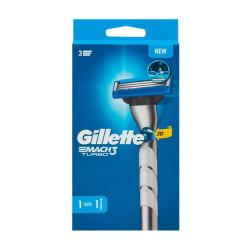
The concept was further developed with Mach3 Turbo, where the three blades received thinner and more flexible microfins than the original Mach3. By lifting the beard hairs and allowing the blades to shave deeper, Gillette aimed for an even better result. The Lubra-strip was also improved with ingredients such as aloe vera and vitamin E.
The downside of Gillette’s multi-blade systems, however, was now becoming increasingly clear: every new blade model required a new razor handle. Each system therefore comes with its own attachment format. You cannot fit a Mach3 blade onto a Sensor handle or Fusion handle and vice versa. Opinions also remain divided regarding the shave quality of Mach3 compared to its predecessor. Some shaving enthusiasts argue that Sensor blades, despite their simpler technology, provide a closer and more effective shave, while Mach3 more easily encourages the user to apply additional pressure, which in turn increases the risk of irritation. The debate, however, continues.
The Fusion series
Fusion/Fusion5: Then came Fusion, the new standard featuring five very closely positioned blades. Aside from the increased blade count and tighter spacing, the major innovation was the addition of a precision trimmer on the back of the cartridge for hard-to-reach areas and trimming sideburns, beards and facial hair, along with a so-called Flexible Comfort Guard featuring 15 soft and flexible microfins for a more comfortable shave.

Further developments of the Fusion technology soon followed, all designed for the same cartridge fitting. From this point onward, innovation accelerated rapidly with new technologies and specialist variants that, unlike the standard Mach3 and Fusion models, may only be found in more well-stocked stores. First came Fusion5, where the blades became thinner, the cartridge lighter, and the Lubricate-strip expanded.
Fusion ProGlide/ProShield: The next step was to create a more flexible cartridge head. With Fusion ProGlide and ProShield, Gillette went even further by giving the first four blades in the five-blade cartridge their thinnest profile yet. At the same time, the innovative FlexBall technology was introduced, allowing the cartridge head to move side to side and follow facial contours more easily for maximum contact. With ProGlide, Gillette also introduced a MicroComb designed to guide and lift beard hairs into the correct position more effectively. ProShield further expanded the lubricating technology so that it not only moisturised during shaving, but also afterwards.

Fusion Power: Innovation continued. The various models in the Power series introduced features such as a battery-powered motor inside the razor handle, intended to reduce friction through micro-pulses and allow the cartridge head to glide more smoothly. Opinions on this invention remain highly subjective – some users feel it significantly improves the shaving experience, while others prefer the simplicity of the original non-powered models.

Gillette SkinGuard
Gillette’s latest addition to the market is the so-called SkinGuard razor, specifically designed for sensitive skin and to minimise the risk of razor bumps and irritation.
What virtually all multi-blade systems have in common is that the blades first lift the hair, cut part of it off, after which the remaining portion of the hair retracts beneath the skin again. If you are unlucky, razor bumps and other issues may occur when the follicle becomes blocked or clogged. With SkinGuard, Gillette returned to a two-blade cartridge, but with the important difference that the blades are spaced further apart. Between them, a plastic strip has been added to smooth the skin, while the blades themselves are designed not to press as aggressively against the skin, thereby reducing irritation. According to many reviewers who have tested it so far, it may well be the best product Gillette has released since the twin-blade Sensor Excel – although the price of the cartridges could be considered a drawback.